
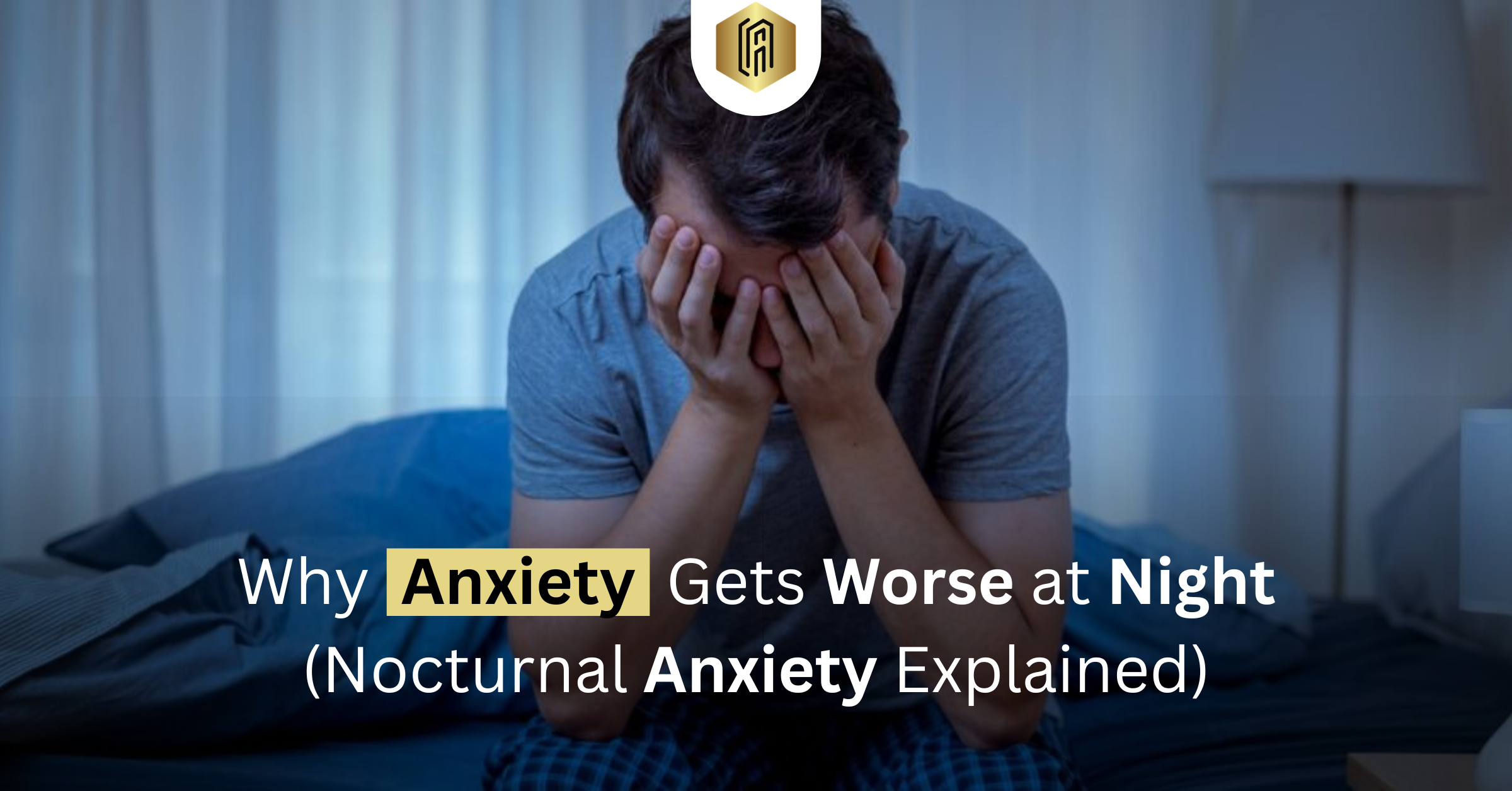
For many with anxiety, nighttime is the opposite of rest. Anxious thoughts are more noticeable when the day is winding down, and there are fewer distractions. All of the worries from health to work to relationships to finances to future can be difficult to ignore, and the physical feelings of a racing heart, restlessness, or tension may make it harder to relax.
This type of experience is termed “nocturnal anxiety,” and it is common and has a significant impact on sleep. Knowing can help control anxiety better.
What Is Nocturnal Anxiety?
Nocturnal anxiety is defined as heightened levels of worry, fear, or mental “busyness” during the evening or night hours. It is not a syndrome in its own right but rather a feature seen commonly in generalized anxiety, panic disorder, stress-related disorders, and insomnia.
Difficulty “switching off” one’s thinking once they lie down is a common experience for those who suffer from nocturnal anxiety.
Instead of sounding sleepy and relaxed, the mind becomes more alert and returns to review previous activities and anticipate future issues. The body may also feel “on guard” and not relaxed. This can be muscle tension, restlessness, or a sense of being “on edge” with no apparent reason for feeling this way in a safe and calm environment.
Why Anxiety Often Worsens at Night
There is a clear reason anxiety tends to intensify when the day ends. It’s not a coincidence, and it’s not something wrong with you! Rather, it expresses the brain’s adaptation in response to more calming, low stimulation, and inner processing.
Fewer distractions allow anxious thoughts to surface
The brain works hard during the day and handles the demands of the day, conversations, tasks, etc. This brings off the notion of doing things by oneself. The mind goes inward at night, when outside stimulation is reduced to the minimum. When there are no distractions, that which is already “on hold” can come to a head. This is why some folks always feel fine during the day and not at night.
The brain shifts into a reflection mode.
During the sleep phase, the brain automatically starts to work on what it felt, remembered, and left unprocessed throughout the day. This contemplative mood might progress to rumination for an anxious individual. The mind might repeatedly review problems, think of all the worst-case scenarios, or reminisce about what it has done wrong. As soon as this loop starts, it can feel challenging to break it.
The body’s stress system is still active.
Anxiety is more than mental; it is physical. The fight-or-flight system of the body, with which we relate more commonly, can also be turned on in stressful circumstances that are not real emergencies. If the system gets activated, there is a possibility for the stress hormones, cortisol and adrenaline, to remain high. This overactivity can actually disrupt restfulness and falling asleep at night when the body should be sleeping.
The Role of the Nervous System in Nighttime Anxiety
It’s useful to examine the relationship between stress and relaxation from the perspective of the nervous system when it comes to understanding nocturnal anxiety. When deciphering nocturnal anxiety, it is important to take a look at the nervous system’s ability to control stress and relaxation.
There are two main systems of the nervous system. One is for action, alertness, and problem-solving. The other’s role is to rest, digest, and recover. Saving the body into the resting phase gradually at night would be best.
But when there is extended stress or prolonged emotional tension or things are generally downright anxious, it may be challenging to get that system to relax completely.
The body, on the other hand, can be hypersensitive and stay a little bit receptive even in safe surroundings. This can make it feel like you’re in bed, but on a physical level, you aren’t. As a consequence, even trivial ideas can be powerful, and sleep eludes you more readily.
Common Triggers of Nighttime Anxiety
Often, nocturnal anxiety is related to concerns during the day more than anything else.
One of the more common ones is stress accumulation. Feelings can get stuck during the day and come out at night when there is time alone.
Other lifestyle factors may be important as well. Eating late at night, using stimulating content before retiring to bed, and using too much screen time at night are all ways that a person’s brain remains alert. Some sensitive people can be affected by caffeine even if they are used to it in the first part of the day.
Emotional factors are also a factor. If there are anxiety feelings that haven’t been ground out at the time, if there is some tension in the relationship, or more uncertainty about life situations for building relationships, they can be more obvious at night when external noise is diminished.
How Nocturnal Anxiety Affects Sleep
The difficulty with worrying at night is how it affects sleep quality. The mind doesn’t allow the body to relax into sleep when it’s busy and tight. At times, even if they do get to sleep, it can be superficial or even restless.
However, a large number of people experience restless minds and have trouble falling asleep at night. Over the years, this can cause frustration and disappointment regarding sleep time.
This fear can go in a circle. The brain becomes more alert at night by being more concerned with not sleeping. This may be called sleep-related anxiety and can help prevent sleep episodes.
Emotional and Cognitive Patterns That Intensify at Night
Some thoughts are more prominent during anxiety at night. These tend to be overthinking, mental repetition of events, and picturing future scenarios in detail.
The brain receives fewer outside stimuli during sleep to compensate for the thoughts it is experiencing. This can make concerns seem bigger and more imminent than they really are.
Other people also have increased awareness of what is happening in their bodies. For instance, someone’s heartbeat may be felt more strongly when it is normal, leading to more anxiety. This establishes a body-awareness/emotional-regulation cycle.
Practical Ways to Manage Nighttime Anxiety
Anxiety during the night can be very intense, but it can respond very well to clearly defined, consistent, and supportive strategies. The purpose is not to completely stop thinking, but to try to suppress any physiological or mental reactivity to thoughts before retiring to sleep.
- One of the best ways to do this is to have a routine for winding down. This can cue the brain that it will soon be time to get ready for sleep. Activities like slow breathing, light reading, or calming music can support this transition.
- Relaxation techniques such as slow breathing, light reading, or soothing music can help with this. Also, it can help to minimize stimulation prior to sleep. This includes reducing screen time, particularly exposure to emotionally charged and/or highly engaging content.
- One of the other major strategies is to externalize thinking earlier in the evening. Diaries can be useful for jotting down concerns or things to do for the following day, helping avoid worries coming back at night.
- Slow down the grounding techniques and use some during the night when anxiety shows up. Slow breathing, relaxation of the body, and/or sensory awareness can help to switch the nervous system to a more relaxed state.
When Nighttime Anxiety May Need Professional Support
If anxiety is part of a person’s life habit, there are occasions when it might necessitate professional help. You may feel worried from time to time; that is normal, but if your anxiety regularly disrupts your sleep and/or any other part of your life, then you may benefit from seeking professional help.
If sleep problems last for more than a few weeks, anxiety seems unmanageable, and there is a noticeable difference in mood, concentration, and energy levels during the day. Mental health professionals can help identify underlying causes and develop personalized treatment approaches.
Some types of therapy can be especially helpful for unhelpful thoughts as well as sleep issues, particularly the CBT for Anxiety and CBT for Insomnia therapies.
At Ascension Psychiatric Services, we help people recognize below what their anxiety symptoms are stemming from and build them simple yet powerful and maintainable solutions to emotionally regulate themselves and improve sleep.
Final Thoughts
Nighttime anxiety is not simply “overthinking before bed.” A combination of the things that have to do with the brain, the emotions, and the behavior, which emerge at moments when there is no noise around.
The key to remember is that it is a manageable pattern. By understanding the process and providing the necessary support, the brain can learn to switch into “rest” more fluidly, and nights over time can become more restful.
If you are struggling with anxiety that feels worse at night, reaching out for guidance can be a meaningful first step toward better sleep and emotional balance.
Related Posts:
FAQs
Why does anxiety feel worse at night, even if I was fine during the day?
There are no distractions at night, and the brain is more able to focus on its thoughts. This also has the potential to bring up other concerns that may have been “set aside” during the day, worsening the strength of anxiety.
Can nighttime anxiety cause insomnia?
Yes. It’s more challenging to fall asleep or stay asleep when your mind is remaining active or your body is holding onto tension. This may become a vicious cycle in time, whereby anxiety and insomnia become more of a problem for one another.
Why do I feel physical symptoms like a racing heart or tight chest at night?
Anxiety turns on the body’s stress response system, prompting levels of hormones (adrenaline!) to rise. This can lead to both physical effects like increased heart rate, muscle tension, or restlessness, and even at night.



)
No comment