
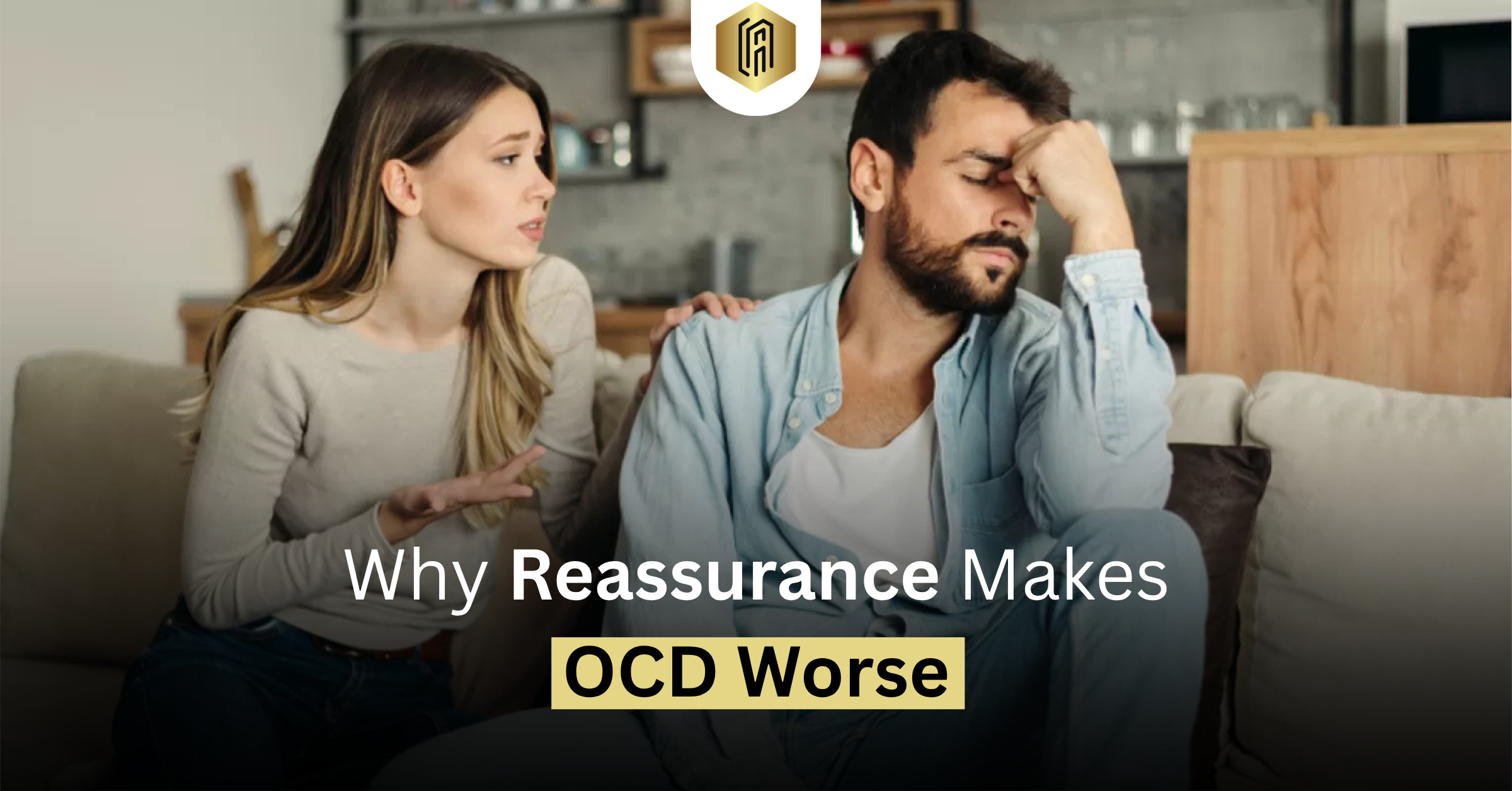
You’ve probably seen this scenario if you have OCD: some intrusive thought comes up, your anxiety goes up, and you feel the need to ask someone, “Are you sure?” or “Is this okay?” This scenario is quite common for people with OCD. Once you find the answer, your anxiety subsides, for a short time. So, the doubt lingers again and usually in a more potent or modified manner. Reassurance is a helpful momentary relief. In fact, it turns out to be one of the most widespread methods used by OCD to “cling” to us.
Understanding Reassurance as a Compulsion
With OCD, reassurance is not regular information-seeking. It acts as a compulsion or mental act that is executed to alleviate discomfort and/or to achieve a feeling of security. This may feel like asking a partner, parent, or friend for reassurance repeatedly, looking online for answers, going over past events in your thoughts, and asking yourself the question many times over again.
The short-term relief is real. That’s exactly why this behavior is sticking. The doubt becomes significant for your brain, and a resolution to alleviate your discomfort is to seek an external resolution. Over time, people start needing reassurance more often, even for small worries, and the frequency and nature of the reassurance increase over time.
How Reassurance Strengthens the OCD Cycle
OCD flourishes on uncertainty and the notion that something needs to be resolved before you can get ahead. When you seek reassurance, several things happen:
- The sense of anxiety is temporarily reduced, thus strengthening the feeling of the need to perform the compulsion.
- You lose the opportunity to realize that you don’t need a ritual to get rid of your anxiety.
- Your brain interprets the original doubt as being more important and meaningful because you followed it.
- The next time a thought of reassurance arises, the need will be even more powerful and rapid.
It is important to remember that this is why the same response that may have been comforting to you before doesn’t always work. OCD then starts to seek explanations and clarifications, or requires evidence from other sources. The original question may lead to the development of an extremely time-consuming pattern that can interact negatively with everyday living and relationship dynamics.
Why the Relief Never Lasts
Reassurance does not address the actual intolerance of uncertainty that underlies OCD. It simply postpones the discomfort. The anticipation of the feared outcome comes back because the worst case has never been fully tried and tested and because absolute truth is seldom achievable. The cycle goes on repetitively, rather than helping your brain learn how to push restart. The individual rounds of gratification only keep the cycle rolling, without teaching your mind different directions to go.
Mental reassurance (e.g., reviewing conversations, examining emotions, etc., or trying to “work out” a solution in your mind) is the same. Even if no one else is in the case, the mental checking offers comfort and helps reinforce the need for certainty.
The Impact on Relationships and Daily Life
If reassurance is overdone, there is the potential for loved ones to become feeling bombarded, confused, or drained. They may begin to respond carefully or may not provide an answer to some questions. In the meantime, the train of relief may be too fast for the person with OCD, and they might feel ashamed or frustrated. When everything is a guess, it can be more difficult to make choices and decisions each day and to interact socially.
A first step is to realize that this is OCD related and not a cause of irresponsibility or not caring.
What Helps Instead of Reassurance
The best method for decreasing reassurance-seeking is based on Exposure and Response Prevention (ERP), the psychologically accepted standard treatment method for OCD. ERP involves gradually rehearsing dealing with uncertainty or triggers in an attempt not to ask for reassurance. With time, your brain learns to bear some degree of doubt and that the anxiety subsides without ritual.
Practical steps that support this process include:
- Noticing and labeling the urge (“This is OCD asking for certainty”).
- Delaying the request for reassurance, starting with short periods and gradually increasing the time.
- Reducing the number of times you ask about the same concern.
- Practicing statements that allow uncertainty (“Maybe, maybe not—I can handle not knowing right now”).
- Redirecting attention to a valued activity once the urge is noticed.
Loved ones can also help by offering support without feeding the cycle. Simple responses such as “I know this is hard, and I’m here with you” or “I’m not going to answer that question again, but I can stay with you” often prove more helpful long-term than repeated reassurance.
Building Tolerance for Uncertainty
Learning to sit with uncertainty is a skill, not a personality trait. Practice and support are required. The therapy process becomes clear and manageable for many to work with a therapist trained in ERP. Therapy offers a structured approach to pinpoint specific patterns of reassurance, help develop a plan to change them over time, and practice new responses in the safe space of therapy.
Progress is rarely linear. Sometimes, the urge will be very strong, and slips will occur. Whenever you see the pattern, you respond differently and make OCD’s hold weaker.
When to Seek Professional Support
If reassurance seeking is consuming much time, impacting relationships and/or keeping you in the grip of anxiety, then professional assistance can make a difference that helps. A psychiatrist will be able to review the entire situation and determine if ERP is right for you, as well as help you develop skills that will last.
At Ascension Psychiatric Services, we treat OCD with an individualized, caring approach. Virtual visits can increase patients’ awareness of these cycles and provide them with strategies to diminish the power of compulsive reassurance.
Moving Toward Greater Freedom
To people with OCD, reassurance is a solution that tends to keep the problem in motion. Identifying the pattern and learning to act differently in the face of uncertainty can help diminish and/or reverse the urge, and give you back your time, energy, and peace of mind.
Change is possible, and you are not alone if this cycle rings a bell with you: You do not have to keep seeking answers that never fully satisfy the doubt.
Ready to break free from the reassurance cycle? Contact Ascension Psychiatric Services today to schedule a consultation. We’re here to help you take meaningful steps toward relief.
FAQs
Is all reassurance bad if I have OCD?
Not every request for information is a problem. Occasional questions for practical reasons are different from repeated, anxiety-driven seeking of certainty. The key is noticing when the question is driven by OCD and used to reduce distress rather than gather needed information.
What should loved ones do when asked for reassurance?
It helps to offer emotional support without feeding the compulsion. Responses that acknowledge the struggle while declining to answer the OCD question repeatedly are often most useful in the long run. Discussing a plan together outside of high-anxiety moments can make this easier.
Can I stop seeking reassurance on my own?
Some people make progress with self-guided strategies, but many benefit from working with a therapist experienced in ERP. Professional guidance helps identify patterns accurately and provides structured support for lasting change.
This post is for educational purposes only and is not a substitute for professional medical advice. Always consult with a qualified healthcare provider regarding your specific health needs and treatment options.






No comment